The Egyptian Temple in Madrid: Why Templo de Debod Is the City’s Most Photographed Sunset
An ancient Egyptian temple, dismantled stone by stone and rebuilt in central Madrid — and the reason your Instagram feed keeps showing you sunsets in Spain.
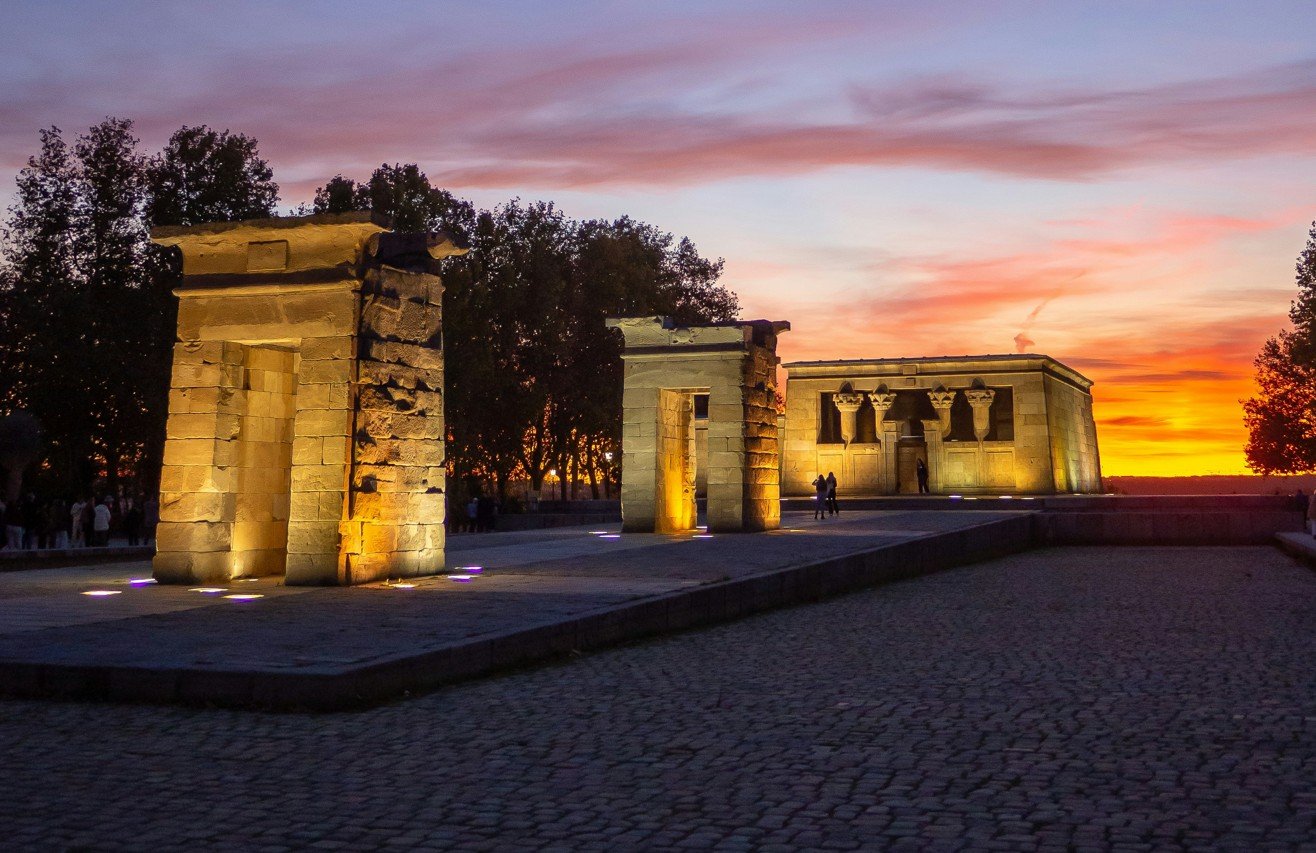
Of all the photos posted on Instagram with the hashtag #madrid, more come from a single small park than from any other location in the city. Not the Prado. Not Plaza Mayor. Not the Royal Palace. A 2,200-year-old Egyptian temple sitting on a low hill on the western edge of the centre the Templo de Debod — produces more daily uploads than every other landmark in Madrid combined.
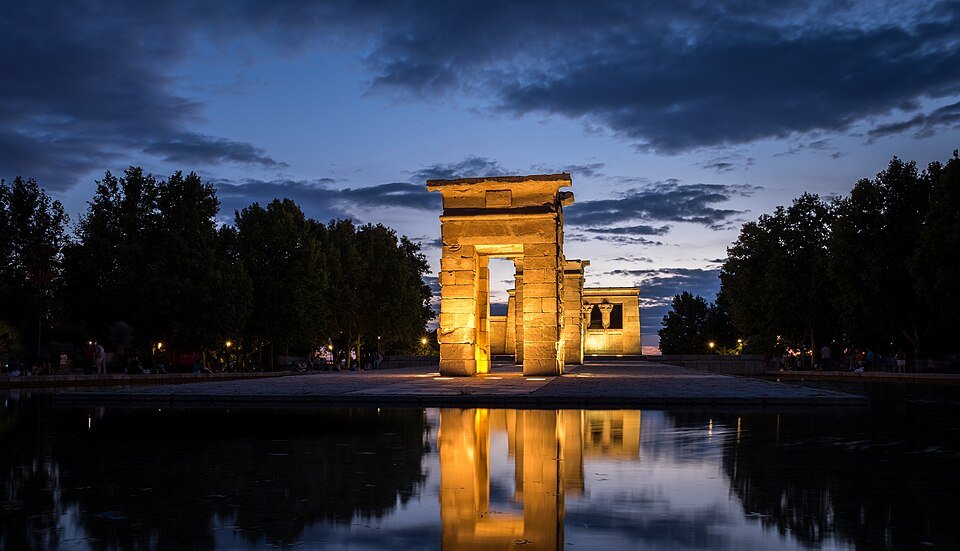
The reason is mostly geographical: it faces west, sits above the surrounding city and offers a clear horizon over the Casa de Campo park and the Sierra de Guadarrama mountains beyond. When the sun sets behind it, the temple’s reflecting pools catch the orange light and the silhouette of a 2nd-century BC Nubian shrine appears suspended over downtown Madrid. The effect is hard to overstate.
But the story behind why a real Egyptian temple is standing in central Madrid is even better than the photograph.
How an ancient temple ended up in Spain
The Templo de Debod was built in the early 2nd century BC, around 200 BC, on the west bank of the Nile in what is now southern Egypt — near Aswan, in a region that was Nubian for most of its history. It was a small temple, dedicated to the god Amun and the goddess Isis, expanded over the following centuries by the Ptolemies and the Romans. For over 2,000 years it stood beside the river, weathered but intact.
In the 1960s, the construction of the Aswan High Dam threatened to flood an enormous stretch of the upper Nile, including dozens of ancient sites. UNESCO launched what became one of the largest archaeological rescue operations in history: cutting major temples apart, transporting them piece by piece and reassembling them on higher ground. The most famous case is Abu Simbel — Ramses II’s colossal temple — which was sliced into 1,036 blocks and rebuilt 65 metres higher.
The Templo de Debod was part of the same operation. Smaller temples that did not warrant individual rebuilding inside Egypt were offered as gifts to the countries that had contributed funds and engineers to the rescue. Four temples left Egypt entirely. One went to New York (the Temple of Dendur, now in the Metropolitan Museum). One went to Leiden, in the Netherlands. One went to Turin. And one was gifted to Spain, in recognition of Spanish engineers who had worked on the Abu Simbel project.
Spain chose to install it not inside a museum, but outdoors, on a low hill near the Plaza de España. The temple arrived in 170 crates in 1970, was reassembled stone by stone (a process that took two years, made harder by the fact that drawings of the original were incomplete), and opened to the public in 1972. It has been one of the most-visited free attractions in Madrid ever since.
What the temple actually looks like
The Debod complex is smaller than first-time visitors expect. The main building — the naos, where the offerings were made — is about ten metres long and six metres tall. In front of it stand two stone gateways, called pylons, which originally framed a processional path from the Nile to the temple. In Madrid, the layout has been preserved as faithfully as possible: the two pylons, then the temple, set on a slight elevation, surrounded by reflecting pools that mimic the river.
You can enter the temple itself for free. Inside are three small chambers, dimly lit, with the original hieroglyphic carvings still visible on the walls. The decoration is delicate — much of it dates from the rule of the Ptolemies, when Egyptian and Greek artistic styles met. A visit inside takes 15 minutes; the temple was never meant for crowds.
But most people do not come for the inside. They come for the view, and they come for sunset.
Why the sunset works
Madrid sits on a plateau at 667 metres above sea level — one of the highest capital cities in Europe — and the air is famously dry and clear. Sunsets here have an intensity that surprises visitors from northern European cities. The colours range from deep orange to magenta, and on good days the entire sky turns pink.
The Templo de Debod sits on the western edge of central Madrid, on a small hill that drops sharply behind the temple toward the Manzanares river and the vast Casa de Campo park beyond. There are no buildings, no obstructions, no power lines — just open sky. The temple itself faces east, so at sunset the sun goes down behind the building, silhouetting it against the colours.
The reflecting pools in front double the effect. On windless evenings, you get a perfect mirror image of the temple in the water with the sky burning behind it.
The best time to be there
The temple gardens are open from dawn until late at night. The best hour, for both photography and atmosphere, is the 30 minutes before sunset and the 30 minutes after. Madrid sunsets vary substantially by season:
- Winter (December–February): sunset at 17:30–18:30. Cold but clear; very photographable.
- Spring (March–May): sunset at 20:00–21:30. The sweet spot — warm air, long twilight.
- Summer (June–August): sunset at 21:30–22:00. The temple becomes the city’s de facto sunset gathering point. Crowded but festive.
- Autumn (September–November): sunset at 19:00–20:30. The most reliably dramatic skies of the year.
If you only have one evening in Madrid, this is where to spend it.
How to photograph it well
The temple is photogenic to the point of being almost cliché. To get a photo that doesn’t look like every other one, consider:
- Shoot from the lower platform, looking up. Most people stand at the same height as the temple and take a horizontal shot. Walk down the steps in front of the main reflecting pool and shoot up at an angle — the temple gains presence and the sky fills more of the frame.
- Wait for the post-sunset glow. The most spectacular colours often appear after the sun has dipped below the horizon, when the sky turns deep magenta. Most visitors leave the moment the sun is gone — stay another 15 minutes.
- Include people. A silhouetted figure against the temple gives scale and emotion that a clean landscape shot doesn’t.
- Avoid weekends if you want a clean shot. On a Saturday in summer there are 500 people in front of the pool. On a Tuesday in November there are 30.
Practical information
| Address | Calle de Ferraz, 1, 28008 Madrid |
| Metro | Plaza de España (lines 2, 3, 10) — 5-minute walk |
| Entrance fee | Free — both the gardens and the temple interior |
| Temple interior hours | Tue–Sun 10:00–20:00 (summer) · 10:00–18:00 (winter) · Closed Mondays |
| Gardens | Always open |
| Best time | 30 minutes before sunset |
| How long to spend | 45 minutes for the view; 1 hour including the interior |
What to combine it with
The Debod sits at the edge of one of Madrid’s most underrated walking areas. Within 20 minutes on foot:
- Plaza de España — Madrid’s largest central plaza, recently renovated, with statues of Cervantes and Don Quixote
- Royal Palace — 10 minutes south, free for EU citizens on selected days
- Sabatini Gardens — formal gardens behind the Royal Palace, free entry
- Calle de la Princesa — main shopping artery if you have time before sunset
For dinner after sunset, the Malasaña and Conde Duque neighbourhoods are a short walk east — Madrid’s most interesting bar and restaurant areas. Our Madrid guide covers the best spots in each.
A small detail tourists miss
The original Egyptian site of the temple is now permanently underwater, hundreds of metres below the surface of Lake Nasser. The Debod you walk around in Madrid is the only version that still exists above ground. There are 2,200-year-old hieroglyphs inside, carved by hands that worked beside a river that no longer exists. You can touch the walls. There is no glass barrier. It is one of the few archaeological sites in Europe where the experience is this direct — and it costs nothing.
Madrid offers many things. This is the most surprising of them.
Read next:
Categories: Practical · Tags: Madrid, Instagram, Sunset, Culture, History