Café ‘t Smalle and the Brown Café Culture of Amsterdam
A 230-year-old canal-side café on the Egelantiersgracht — and a guide to Amsterdam’s most enduring social institution.
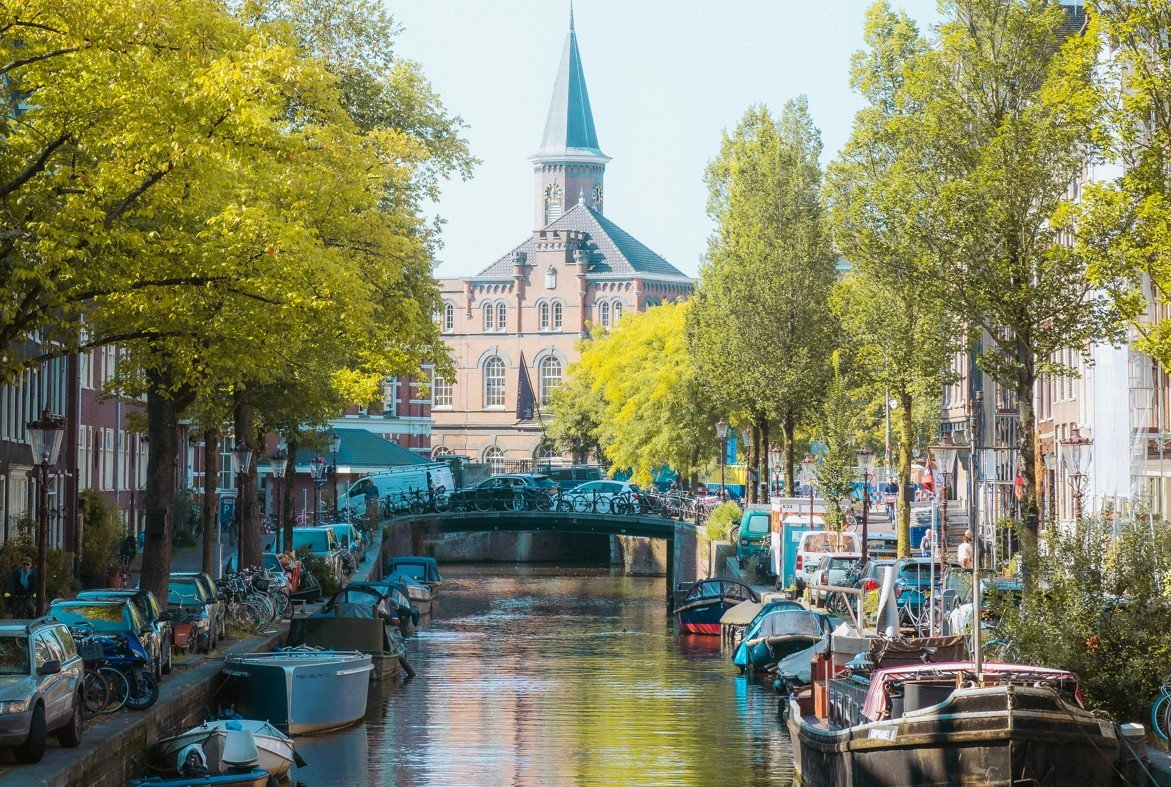
The floating terrace of Café ‘t Smalle sits directly on the Egelantiersgracht canal — one of the most-photographed café terraces in Amsterdam
Amsterdam has many things tourists come for: the canals, the museums, the bicycles, the Red Light District, the coffee shops in the Dutch sense of the word. None of these are how Amsterdam locals actually spend their evenings.
What locals do, four nights out of seven, is meet a friend at a bruin café — a “brown café” — and stay for two or three hours, drinking small beers, talking too loud, and watching the canal go dark through small windows that have not been cleaned since 1974. The brown café is the most Dutch thing about Amsterdam. It is older than the country in its current form. And if you visit Amsterdam without spending one full evening inside one, you have not actually been to Amsterdam.
The most beautiful of them all — by general agreement of locals, food writers, and the international travel press that has belatedly discovered it — is a small, dark, wood-panelled room on a canal in the Jordaan called Café ‘t Smalle.
What a brown café actually is
The name comes from the colour of the walls. Brown cafés have been around in some form since the 17th century, when they were essentially the front rooms of merchants’ houses that doubled as informal drinking establishments. Over centuries of tobacco smoke from clay pipes, the wood-panelled walls and ceilings developed a deep amber-brown patina — and when smoking was banned indoors in 2008, the colour stayed. A real brown café still smells faintly of tobacco from the wood, even though no one has smoked inside one in nearly two decades.
The defining features:
- Small. A real brown café holds 20–40 people at maximum capacity. Anything larger is a different category.
- Wood-panelled. Walls, ceiling, often the bar itself. The wood is rarely refinished.
- Old. The youngest brown cafés are 50 years old. The oldest go back to the 17th century. Most claim a founding date somewhere between 1670 and 1900.
- Beer-focused. The menu is small. The beer list is also small — typically two or three on tap, all Dutch, and a short selection of bottled beers. Wine is available but secondary.
- Sand on the floor. Some traditional brown cafés still sprinkle sand on the wooden floor, a practice that goes back to the 1700s when it absorbed spilled beer and was easier to sweep.
- Tables and chairs that don’t match. The furniture is accumulated, not designed.
- Cats. Most brown cafés have one. Some have several. Officially they belong to the landlord.
The brown café is the equivalent of the English pub or the Viennese coffee house — a piece of social infrastructure so old and so woven into how the country uses its evenings that visitors who skip it have not really seen the city.
Café ‘t Smalle
Café ‘t Smalle (“The Narrow Café”) opened in 1786 as a distillery and tasting room, founded by a man named Pieter Hoppe — yes, the same Hoppe family that still produces one of Holland’s best-known genever (gin) brands. For its first century the café was effectively the tasting bar of the Hoppe distillery; you came to try the gin before buying a bottle to take home. The distillery later moved, but the café stayed, and has been operating continuously since 1786 — making it one of the oldest still-operating cafés in Amsterdam.
It sits on a narrow corner where the Egelantiersgracht meets the Prinsengracht, in the heart of the Jordaan — the historic working-class neighbourhood of Amsterdam, now one of the most charming residential districts in Europe. The Jordaan is a grid of small canals and narrow houses, built in the early 17th century for the artisans, craftsmen and immigrants who served the Golden Age trade. Today it is gentrified but still characterful: small shops, art galleries, weekly markets and a density of brown cafés unmatched anywhere else in the city.
The interior of ‘t Smalle is small — perhaps 25 seats inside — with a long wooden bar running along one wall, a few wooden tables along the other, and a curving staircase leading to a second-floor room with five more tables. The original 18th-century pewter beer taps are still in place. The bottles behind the bar include several still-distilled Hoppe genevers.
In summer, the café has one of the most-photographed terraces in Amsterdam: a floating wooden dock on the Egelantiersgracht itself, with eight small tables that sit directly on the water, two metres below the level of the surrounding canal walls. You sit there with a beer, the houseboats line the canal on both sides, the bridges arch overhead, and bicycles roll past your ear at the level of the bridge. There is no other terrace like it in the city.
What to order
The Dutch beer tradition is light and easy-drinking — the famous brands (Heineken, Amstel, Grolsch) are lagers, but the country also has a strong tradition of witbier (wheat beer), tripel (strong abbey-style ale) and bok (a dark seasonal beer brewed for autumn). At ‘t Smalle, the rotating tap usually includes a Dutch craft brew alongside the standards.
But if you are at ‘t Smalle, the order is genever.
Genever is the Dutch ancestor of gin — a juniper-based spirit that originated in the Low Countries in the 16th century and was drunk so widely in 17th-century England that “Dutch courage” became an English phrase. It is heavier than modern gin, flavoured with grain and malt, and traditionally served in a small tulip-shaped glass filled to the absolute brim. You bend over the table and sip the first mouthful without lifting it — a ritual called the kopstoot, meaning “headbutt”, when accompanied by a small glass of beer.
‘t Smalle still has the original Hoppe genevers on the shelf. €5–8 per glass. Order one. Drink it slowly. Order a Heineken from the tap to go with it.
The Jordaan around it
One of the great pleasures of ‘t Smalle is the neighbourhood it sits in. The Jordaan rewards walking, in any direction, for an hour. Within five minutes of the café:
- Anne Frank House — 3 minutes west on the Prinsengracht. The most important historical site in Amsterdam. Book tickets weeks in advance.
- Westerkerk — the great Protestant church next to the Anne Frank House, with the highest tower in Amsterdam and free entry to the nave on weekdays.
- Noordermarkt — an outdoor farmer’s market on Saturday mornings, with organic food and an antique market on Mondays.
- Nine Streets (De 9 Straatjes) — the famous shopping district between the Singel and the Prinsengracht, with independent boutiques.
An ideal Jordaan day: morning at Anne Frank House, lunch at one of the Nine Streets cafés, afternoon walking along the inner canals, evening starting with a kopstoot at ‘t Smalle.
Other brown cafés worth knowing
‘t Smalle is the most famous, but the city has dozens of similar places. The shortlist:
- Café Hoppe (Spui 18–20) — founded 1670; the oldest still-operating brown café in Amsterdam; famously crowded
- Café Chris (Bloemstraat 42) — in the Jordaan; established 1624; the bar with the longest history of continuous service in the city
- De Drie Fleschjes (Gravenstraat 18) — founded 1650; specializes in genever; behind the Royal Palace
- Café Karpershoek (Martelaarsgracht 2) — founded 1606; the oldest pub in Amsterdam by some accounts; near Centraal Station
- Café Papeneiland (Prinsengracht 2) — Bill Clinton famously dropped in here in 2011 and ate the apple pie; the pie has been famous since
Each of these is worth an evening. Visit two or three on the same trip.
Practical information for ‘t Smalle
| Address | Egelantiersgracht 12, 1015 RL Amsterdam |
| Tram | Lines 13 or 17 to Westermarkt — 5-minute walk |
| Hours | Monday–Thursday 10:00–01:00 · Friday–Saturday 10:00–02:00 · Sunday 10:00–24:00 |
| Reservation | Not accepted — first come, first served |
| Best time | 17:00–19:00 (early evening, fewer crowds) or 22:00 onwards (when locals arrive after dinner) |
| Price range | Beer €4.50–6 · Genever €5–9 · Bitterballen (snack) €7 |
| Avoid | Friday and Saturday evenings June–August — the terrace is full and the indoor seats run out by 18:00 |
An evening that works
A good Amsterdam evening: start at 18:30 with a kopstoot on the terrace of ‘t Smalle. Walk along the Egelantiersgracht for fifteen minutes, watching the houseboats. Eat at one of the small Dutch restaurants in the Jordaan — our Amsterdam guide recommends specific places. Finish with one more beer at another brown café — Café Chris or Café Papeneiland — and walk back to your hotel along the dark canals.
That is the night that visitors who came for Anne Frank and the Van Gogh Museum end up remembering longest.
Read next:
Categories: Practical · Tags: Amsterdam, Brown café, Jordaan, Culture, Drinking