Le Train Bleu: The Paris Restaurant Inside a Train Station That Time Forgot
Hidden above the platforms of Gare de Lyon, one of the most spectacular dining rooms in Europe sits in plain sight — and most travelers walk straight past it.
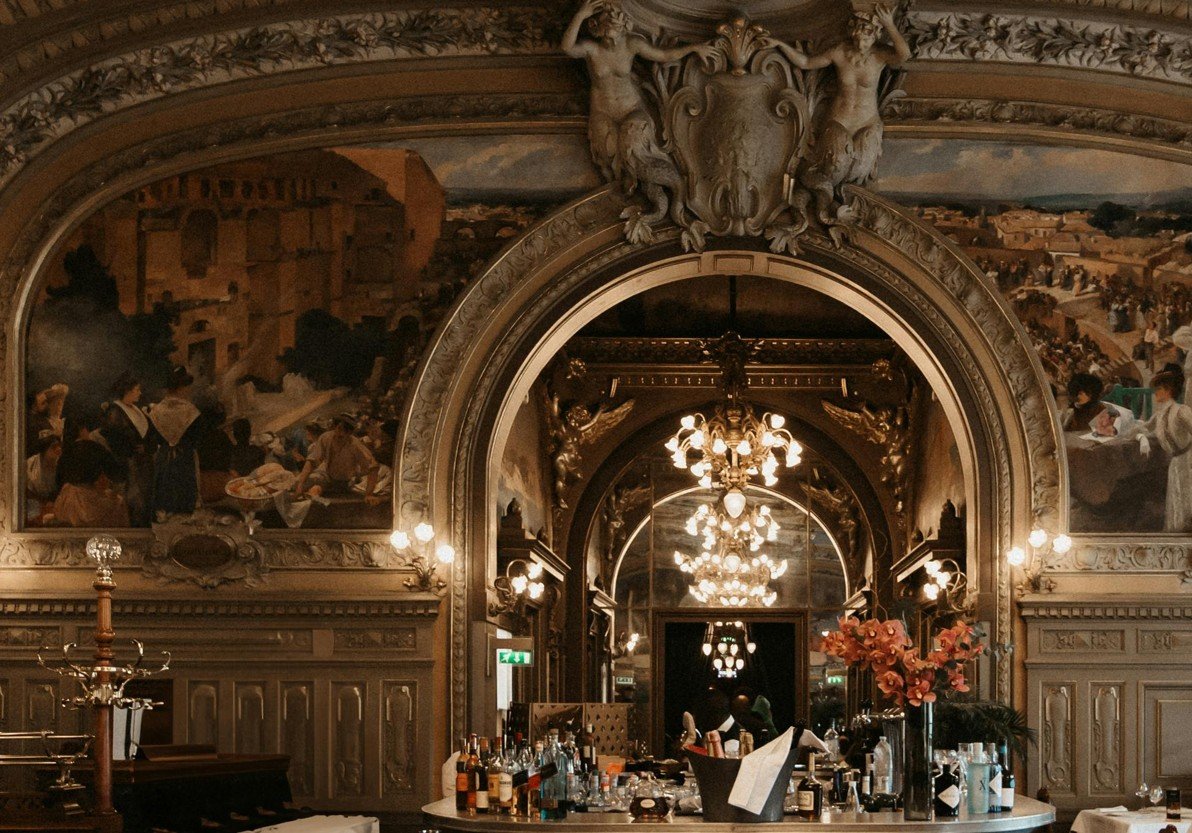
⇒ Le Train Bleu | Restaurant Gastronomique Gare de Lyon | Paris 12
Every traveler who has taken a TGV south from Paris has stood in the great hall of Gare de Lyon, looked up at the clock tower, and rushed to find their platform. Almost none of them have looked up further — to the first floor — where, behind unmarked wooden doors, one of the last surviving Belle Époque dining rooms in the world has been serving passengers since 1901.
Le Train Bleu is not a hidden gem in the modern sense. It has a Michelin Bib Gourmand, a Wikipedia entry in eleven languages, and it has appeared in Luc Besson’s Nikita, Wes Anderson’s promotional shorts and at least three Mr. Bean films. And yet, walk past Gare de Lyon on a Tuesday afternoon and you will see hundreds of tourists pass under it without realizing it exists.
A restaurant built for the speed of trains
To understand Le Train Bleu, you have to understand what train travel meant in 1900.
The Universal Exposition of 1900 was Paris’s defining moment. The Eiffel Tower (built for the 1889 exposition) was barely a decade old. The Grand Palais and the Petit Palais were going up across the river. Electricity was new. The Métro had just opened. And the Compagnie des Chemins de Fer de Paris à Lyon et à la Méditerranée — the railway company connecting Paris to the French Riviera and Italy — wanted a station that would announce, the moment passengers arrived, that they were about to enter a golden age of travel.
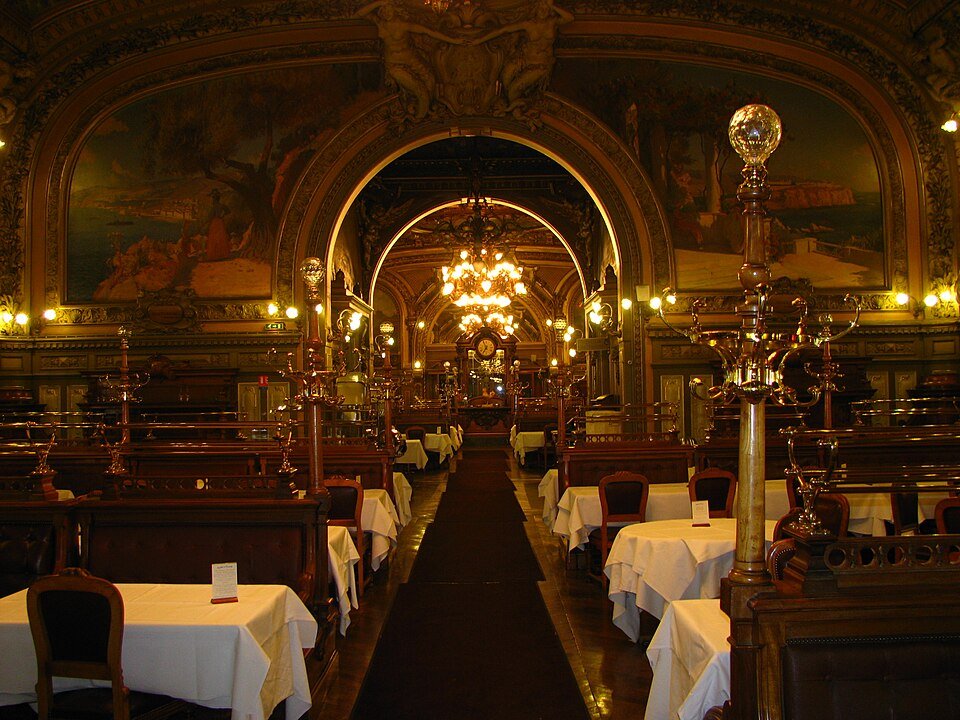
The result was Gare de Lyon. Above its great hall, the railway commissioned a restaurant whose mission was simple: to make waiting for a train an experience worth photographing. The architect, Marius Toudoire, gave it 41 painted ceiling frescoes — one for each destination the line served, from Lyon and Marseille to Nice, Monte-Carlo and beyond. He covered the walls in gold leaf. He installed massive crystal chandeliers. He had the chairs upholstered in deep blue velvet — a tribute to the legendary train bleu sleeper service that ran overnight from Calais to the Côte d’Azur, beloved of writers, royalty and runaway lovers.
The restaurant opened in 1901. It has been continuously serving meals — almost without interruption — for over 120 years.
Walking in for the first time
The entrance is deliberately understated. A wooden double-door on the first level of the station hall, marked by a small sign that says only Le Train Bleu. There is no pavement, no patio, no street presence. You step inside expecting a station bistro and you stop in your tracks.
The main dining room is 80 metres long. Three crystal chandeliers, each weighing more than a tonne, hang from a ceiling covered in painted views of Marseille, Algiers, Toulon and Nice. The bar runs along one wall in carved walnut. The other wall is glass — looking down onto the platforms of Gare de Lyon, where TGVs hiss and announcers call out departures in three languages. You can sit at a white-clothed table, order a kir royal, and watch trains leave for Provence below you.
There is no equivalent in Paris. There may be no equivalent in Europe.
The food: classic French, intentionally so
It would be tempting for a restaurant like this to coast on its decor. Le Train Bleu does not. The menu is supervised by Michel Rostang, a Michelin-starred chef from a multi-generation Parisian family, and the kitchen plays the brief straight: classic French bistronomie, no experiments, no fusion, no foam.
The signature dishes:
- Gigot d’agneau de sept heures — leg of lamb slow-cooked for seven hours until it falls apart at the touch of a fork. Carved tableside.
- Sole meunière — Dover sole pan-fried in butter, finished with lemon, served whole. The waiter fillets it for you at the table.
- Baba au rhum — the most famous dessert of the house. A yeasted cake soaked in your choice of rum, served with whipped Chantilly cream. The bottle is left on the table.
None of this is cutting-edge. All of it is excellent.
How much does it cost?
The à la carte experience is expensive — main courses run €38–65, and a full dinner with wine for two reaches €250–300. But there are two important tricks for visiting on a more modest budget:
The lunch menu
The fixed-price lunch menu is one of the best deals in central Paris. Two courses for €49, three courses for €59 — and you eat exactly the same food, in exactly the same room, as the evening guests. Reservation required.
The bar
Le Train Bleu’s bar — Le Big Ben Bar — accepts walk-ins. You can sit at a marble counter, order a glass of champagne (€18) or a French 75 cocktail, and spend an hour absorbing the room without committing to a full meal. For travelers with a connecting train, this is the move.
Practical information
| Address | 1st floor, Gare de Lyon, Place Louis Armand, 75012 Paris |
| Métro | Gare de Lyon (lines 1 and 14, RER A and D) |
| Hours | Lunch 11:30–14:45 · Dinner 19:00–22:45 · Bar 07:30–23:00 |
| Dress code | Smart casual — no shorts at dinner |
| Reservation | Strongly recommended for dinner; required for lunch menu |
| Best time to visit | Weekday lunch, 13:00 — quieter than evening, full natural light through the windows |
What to look for: the 41 frescoes
Each painted panel on the ceiling shows a city served by the PLM railway in 1900. The most famous ones, and where to find them:
- Marseille — over the main entrance, showing the Vieux-Port
- Nice — central, above the chandeliers, with the Baie des Anges
- Monaco — toward the bar, showing the casino and the harbour
- Algiers — one of the few non-French panels, painted at the height of the colonial era
If you ask politely, the maître d’ will point them out — it is part of the experience.
Why it survived
Most of Paris’s Belle Époque interiors were destroyed in the 1960s and 1970s. The original Café Anglais (where Escoffier invented Pêche Melba): demolished. The original Maxim’s interior: heavily modified. Most grand hotel dining rooms of that era: converted to conference space.
Le Train Bleu survived for three reasons. First, it was inside a working train station — when railway modernization came in the 1960s, the operators decided it was easier to leave the restaurant untouched than to move it. Second, it was classified as a Monument Historique in 1972 — meaning nothing inside can be altered without state approval. Third, and most importantly, Parisians kept coming. The restaurant has never lost its loyal lunch crowd: lawyers from the nearby Bercy courts, civil servants from the ministries, train enthusiasts and the people who simply love beautiful rooms.
What to do after
If you visit Le Train Bleu for lunch, you have the afternoon free in one of the most underrated arrondissements in Paris.
- Walk to Bercy Village (15 minutes) — old wine warehouses converted into shops and restaurants along cobbled lanes
- Cross the Seine to the Jardin des Plantes (20 minutes) — Paris’s botanical garden, founded in 1626, with a small zoo and a free natural history collection
- Visit Promenade Plantée — the elevated park that inspired New York’s High Line, starting just behind the station
For more about the 12th arrondissement, see our complete Paris guide.
One last detail
Look at the floor when you walk in. The original 1901 mosaic tiles are still in place — small navy-blue squares spelling out, in classical Roman letters, Buffet de la Gare de Lyon. It was the restaurant’s first name. The “Train Bleu” name came later, in 1963, in tribute to the sleeper that no longer runs.
The train is gone. The restaurant is still here.
Read next:
- Destovia’s complete Paris guide
- Paris vs Rome: Which Should Be Your First European Trip?
- More articles on the Destovia blog
Categories: Food · Tags: Paris, Restaurants, Historic, Belle Époque, Hidden gems