Jardins de Laribal: The Barcelona Garden That Tourists Walk Past Every Day
Hidden on the slopes of Montjuïc, between the MNAC and the Olympic stadium, lies one of the most beautiful and least visited gardens in Barcelona.
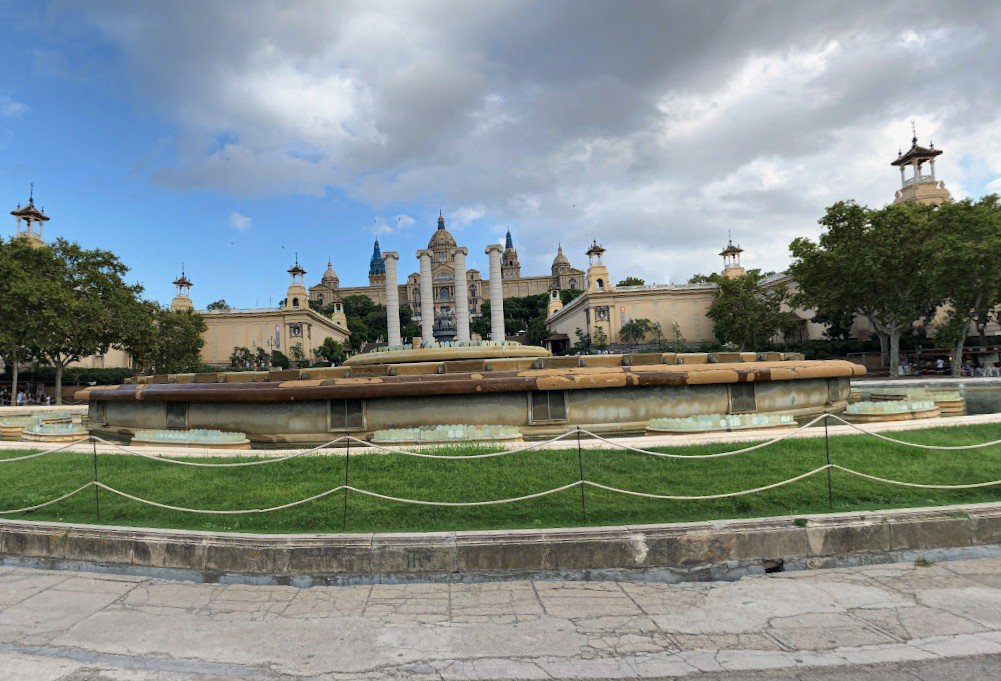
The water terraces of the Jardins de Laribal on the slopes of Montjuïc a Mediterranean garden hidden in plain sight.
Park Güell is the garden every visitor to Barcelona knows. Twelve million people see its mosaic dragon each year. The entry fee has risen to €10; the queues stretch around the hill; the panorama is photographed so often it has become difficult to see clearly. It is, without question, one of the most extraordinary park projects in Europe — and the most overcrowded.
What very few visitors know is that on the opposite side of the city, on the slopes of a different hill, there is another historic garden — equally beautiful, equally important, designed by some of the same craftsmen who worked with Gaudí — that costs nothing to enter, never queues, and on most weekday afternoons is occupied by perhaps thirty people in total. It is called the Jardins de Laribal. And it is, for many people who have spent time in both, the more beautiful of the two.
The garden and its hill
Montjuïc is the small mountain that rises behind Barcelona’s port — the city’s natural lookout point, used as a fortress from Roman times through the 20th century, and the site of the 1992 Olympic Games. The hill is covered in parks, museums, the great Catalan art museum (the MNAC), the Joan Miró Foundation, the Magic Fountain and a number of smaller gardens. Most visitors come to Montjuïc for the views and the museums, ride the cable car up, see one or two attractions, and leave.
The Jardins de Laribal sit on the eastern slope of Montjuïc, between the MNAC and the Joan Miró Foundation. They are technically marked on the map but rarely on the tourist itinerary. The garden was laid out between 1917 and 1922 by the French landscape architect Jean-Claude Nicolas Forestier and the Catalan architect Nicolau Maria Rubió i Tudurí — both of whom were working at the same time as Antoni Gaudí, drawing from the same tradition of Catalan Modernisme, and using the same artisans (mosaic-makers, ironworkers, stone-cutters) who had built Park Güell a few years earlier.
The result is a Mediterranean garden in the strict sense — meaning a garden built around the management of water on a dry hillside, in the tradition that runs from ancient Persia through Moorish Andalusia to early 20th-century Spain.
What you see when you walk in
The garden is built on a steep slope, and the design exploits this in a sequence of terraces connected by staircases. Each level has a different character. The lower terraces are formal and geometric, with hedges, gravel paths and pergolas dripping with wisteria in spring. As you climb, the geometry loosens, the planting becomes wilder and the water features become more prominent.
The signature element is the Font del Gat (“the Cat’s Fountain”), a small octagonal fountain set in a shaded grotto halfway up the slope, decorated with the same kind of broken ceramic tilework (trencadís) that Gaudí made famous at Park Güell. The fountain itself is named after a cat-shaped stone spout that is now mostly worn away. Next to it stands a small restaurant — La Font del Gat — which has operated since 1922, closed during periods of upheaval, and is now once again open for lunches under the trees.
Above the fountain runs the most theatrical part of the garden: a series of cascading water staircases, each step a small basin, designed to slow rainwater and channel it down the hillside. The sound of running water follows you for the entire walk. In summer, the temperature inside the garden is several degrees cooler than the surrounding streets.
At the very top, the garden opens onto a wide terrace with a view across the Olympic stadium and toward the city. The skyline of Barcelona — the Sagrada Família in the distance, the Torre Glòries, the cranes of the port — is visible from a vantage point almost no one knows about.
Why almost no one is here
The garden’s obscurity has three causes.
First, it is not signposted from any major tourist artery. You can stand on the steps of the MNAC, three minutes away, and have no idea the garden exists. The official Barcelona tourism map shows it but does not promote it.
Second, the entrance is hidden. The most direct access is through a small gate on Passeig de Santa Madrona, opposite the Archaeology Museum — a gate that looks like the back entrance to a private property. Many visitors who reach this gate, even on purpose, second-guess whether they are allowed inside.
Third, the garden has no single famous feature. There is no dragon. There is no glittering panorama at a specific photographic spot. It is a place that rewards walking, sitting and noticing — none of which fits the speed of the modern guidebook itinerary.
For visitors who appreciate this kind of garden — and they exist in every generation of traveller — the result is one of the most peaceful hours you can spend in Barcelona.
The best route
The garden is most beautiful when entered from the top and walked downhill, following the water.
- Start at Plaça d’Espanya — the major square at the foot of Montjuïc. Walk up the grand staircase past the Magic Fountain toward the MNAC.
- Pass the MNAC on its left side. Continue along Passeig de Santa Madrona for about 300 metres.
- Enter the garden through the small gate on your right. There is usually a small painted sign — easy to miss.
- Walk downhill through the water terraces, past the Font del Gat, and out the lower gate near the Greek Theatre (Teatre Grec).
- Continue down to either the Joan Miró Foundation or, with a longer walk, to the Olympic Stadium.
The total walk takes 30–45 minutes. With a coffee at the Font del Gat restaurant, an hour and a half.
When to visit
| Best season | April–May (wisteria in bloom) and October (autumn colour) |
| Worst season | August (hot, dry, less green) |
| Best time of day | Late morning (10:00–12:00) or late afternoon (16:00–18:00) |
| Avoid | Midday in summer — the open terraces lose their shade |
Practical information
| Address | Passeig de Santa Madrona, 28, 08038 Barcelona |
| Metro | Espanya (lines 1, 3, 8) — then 15-minute uphill walk, or escalators from Avinguda de Maria Cristina |
| Entrance fee | Free |
| Hours | Daily 10:00–20:00 (summer) · 10:00–18:00 (winter) |
| Restaurant | Font del Gat — Tuesday–Sunday lunch only · 12:30–16:00 · €25–40 menu |
| Accessibility | The garden has many staircases and is not fully accessible |
What to combine it with
The Jardins de Laribal sit at the centre of the cluster of Montjuïc attractions. A good Montjuïc day:
- Morning: MNAC (the National Art Museum of Catalonia) — one of the great collections in Europe
- Lunch: Font del Gat restaurant inside the garden
- Afternoon: Joan Miró Foundation — 15-minute walk along the slope
- Sunset: Walk up to Montjuïc Castle for the panorama of the city and the sea
- Evening: Magic Fountain show at the foot of the hill (Thursday–Saturday evenings in season)
For more on Barcelona’s other gardens and parks, see our complete Barcelona guide.
The bigger picture
Park Güell is beautiful and worth seeing once. But the Jardins de Laribal answer a different question: what does Barcelona feel like when there are no other tourists in it? The answer, on a Tuesday afternoon in October, listening to water move down a 100-year-old staircase under wisteria vines, is one of the better answers any city in Europe can give.
Read next:
Categories: Practical · Tags: Barcelona, Gardens, Montjuïc, Hidden gems, Walking